|

Detecting
and Eliminating Mold Growth in your home:
If you have an
uncomfortable musty smell indoors in your home or office environment,
you may have mold growth in places where you either may or may not be
able to see it. In some cases these dangerous molds can be responsible
for mycotoxins released in the air which can cause allergies or worse.
Don't be mistaken. Mold
growth can occur just as easily in Colorado homes as anywhere else, even though the
outside climate is generally dry.
At RHMM we choose from a
variety of physical monitoring tests to determine whether there is a
source of mold that could be threatening the health of your family
right in your own home.
Measure Mold
Spore Spectrum and Concentration in Your Home
At RHMM we can do a
physical test whether there is a source of an indoor air problem caused
by mold. By analysing the spectrum of data obtained from such a test we
can determine the fingerprint of a specific mold type that causes the
problem.
 Mold Spore Concentration test Mold Spore Concentration test
Example of test results for various home
conditions:
These are screening tests
inside and outside the house to determine if mold amplification exists
in your home by certain mold types that are known to be unhealthy for
the inhabitants. A certified national laboratory will perform the
sample analysis.
The first two sets of
three measurements were taken in the same building before and after the
mold remediation
The last set of three tests were taken in a building without excessive
mold growth and are shown for comparison.
In each set of three
measurements the O is a test background done outside.
B means bedroom or basement and C means in crawlspace. FL is a
measurement done near the floor in a suspect area.
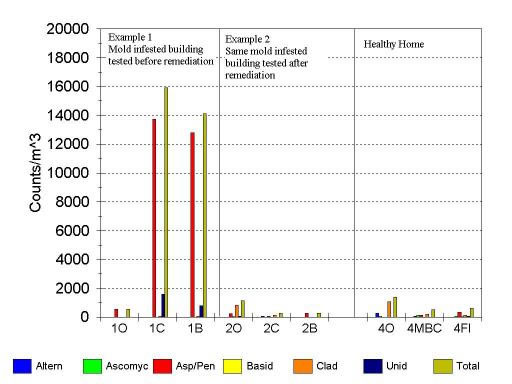
The first set of three
test results shows that the mold infested building was identified
because the spore levels inside were much higher than outside.
The second set of three test results shows that the building had been
successfully remediated to the point that the residual molds are not
expected to cause a health concern in the home.
The importance of an outside test is even more apparent by looking at
the following set of three mold tests for a home where we have drawn
lines beteween the identical mold spore types to guide the eye.
If the lines go upwards mold growth for that type of mold may be
suspected in the indoor environment. Therefore the house where these
tests were done has no suspect mold growth, and the outside air mold
spore concentration is relatively high, influencing some mold spores to
be present inside because of the natural ventilation rate of the house.
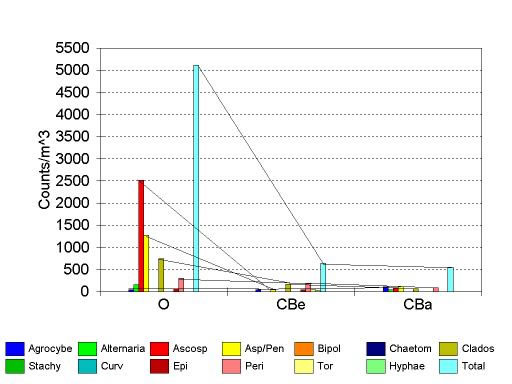
If one (or a few) type(s)
of mold is growing excessively inside the building one will see
the(spore-) fingerprint of that mold type deviating fromt he rest in
the spectrum of mold spores.
Finding Hidden Moisture and Mold Growth
in Your Home
At RHMM we can do a
physical test that points at the location of hidden moisture and mold
via non-destructive testing...
The following are two examples.
The Shower
Wall
In this example it is
suspected that because of a crack in the grouting of the tiles in the
shower area moisture may have accumulated behind the tiles above the
base. See photo:
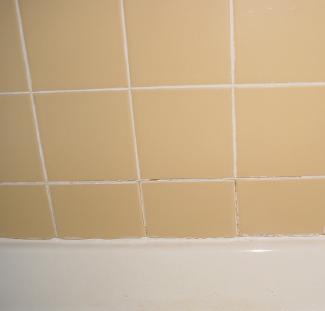
We scanned the area with the moisture scanner. The area-graph below
shows the Relative Humidity summed along the edge of the bottom of the
shower base and in horizontal lines above it as a function of the
height above the edge of the shower base.
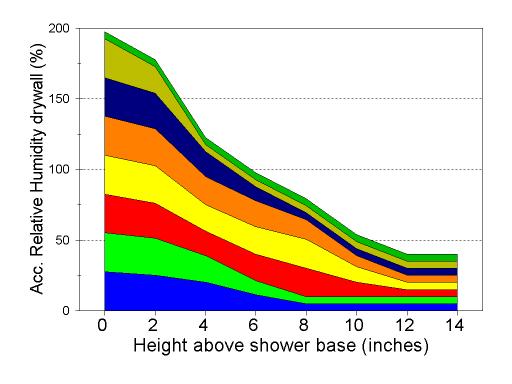
It is clear from this
graph that moisture has already accumulated behind the tiles. If the
problem is not solved this can cause a significant mold problem.
The Shower Ceiling
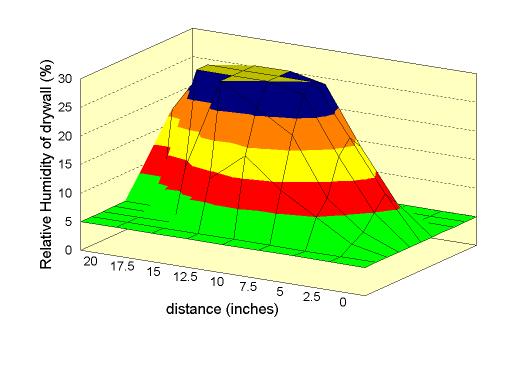
In scanning the ceiling of
the shower area we discovered a fairly large spot of drywall
(approximately 100 square inches) that had a substantial larger
relative humidity than the surrounding drywall ceiling as is shown in
the following three dimensional graph:
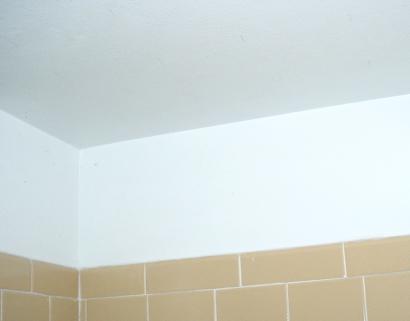
There was no visible indication of a water stain, a wet spot or bulging
of drywall as the following photo of the same area shows.
After further
investigation we discovered that there was a leak from the bath-tub in
the bathroom above it.
Once the ceiling was opened a mold investigation via the tape lift
method identified excessive mold growth (hyphae) on the inside cavity
between ceiling and flooring.
This example shows how we
can find mold growth that was still shielded from the naked eye via a
non-destructive method by using the moisture scanner. By solving the
problem at this time we can prevent future adverse health effects for
the occupants that may be the consequence of excessive mold growth.
<<
Previous
[Learn About Radon]
|