"Test
for peace of mind,
mitigate when high."

Latest News:
August 4, 2018
A new scientific study in Environmental Health Perspectives estimated the
global lung cancer mortality attributable to Residential Radon over the year
2012. This value (PAR) for the sum of all 66 countries studied was estimated to
be 226,057 individuals. Authors: J Gaskin, D. Coyle, J. Whyte and D. Krewski, Environmental Health Perspect, https://doi.org/10.1289/EHP2503
July 17, 2018
TIP: It is important that radon tests are done during “closed-house
conditions” of the home, meaning windows on all levels and doors to outside are
closed, except for going into and out of the house. In the Summer ‘whole-house AC
units’ can be operating on Auto, but ‘window AC units’ should not be used
during the test.
December 28, 2017 January
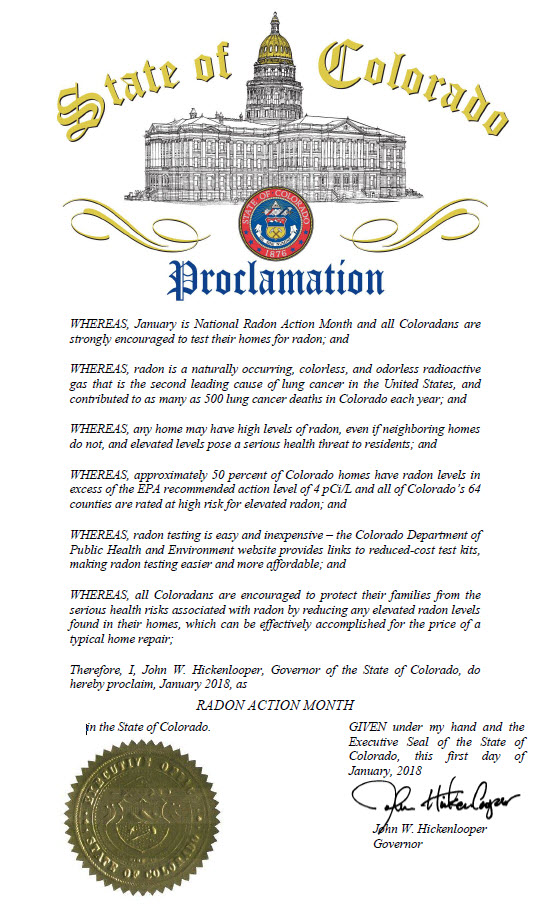
2018 will be Radon Awareness month in Colorado and in all of the United States. The
State has written a
Proclamation to this effect. The Colorado Department of Public Health
charged with the Radon issue will send out a press release in January
with this proclamation to the public. Click on the following image
to read in detail: Signed by Governor John Hickenlooper.
Sept 1, 2017 Dr. Moorman renewed his membership with the AARST. he has now been a Professional AARST member for 18 years.
July 14, 2017 Today
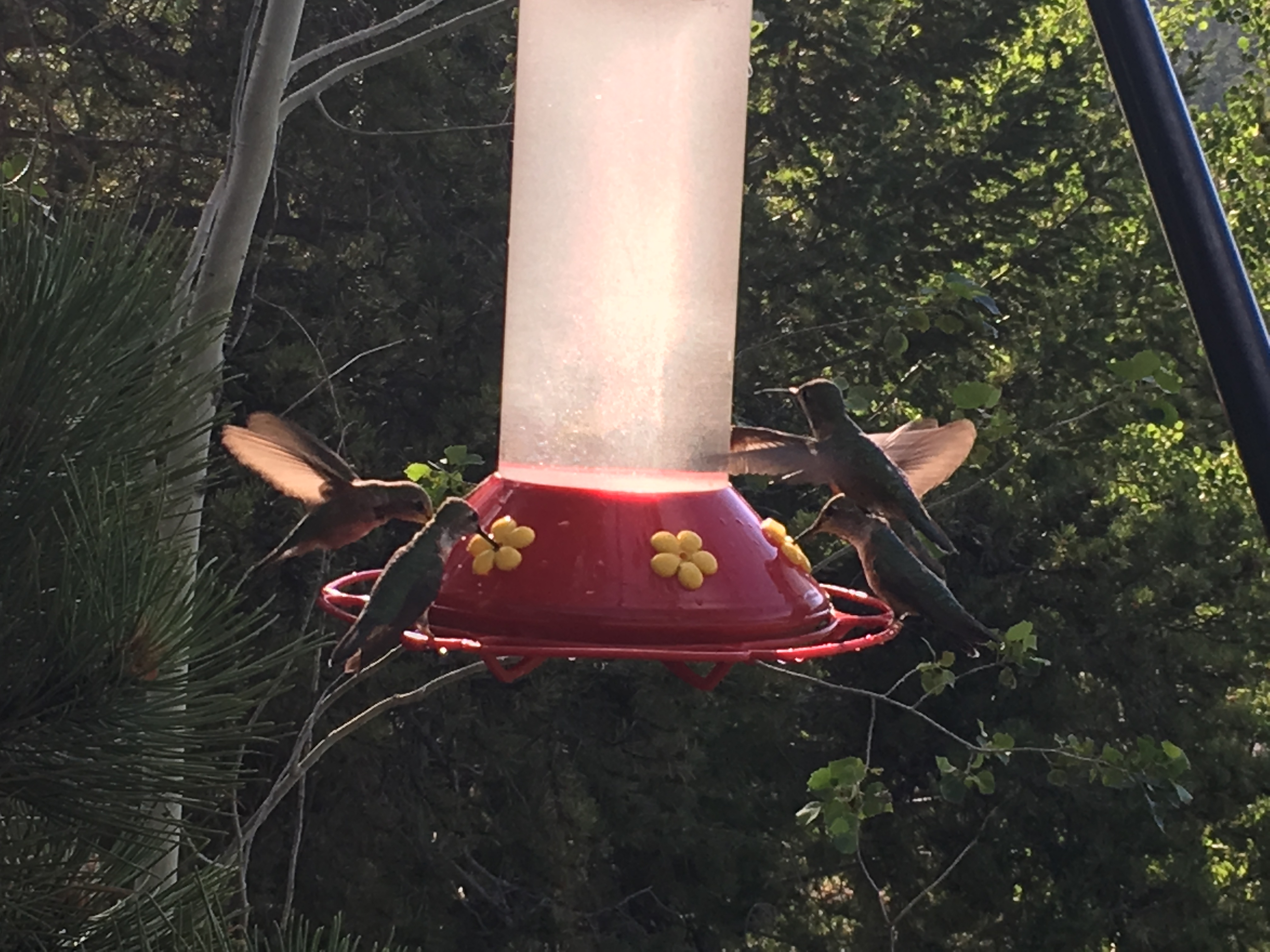
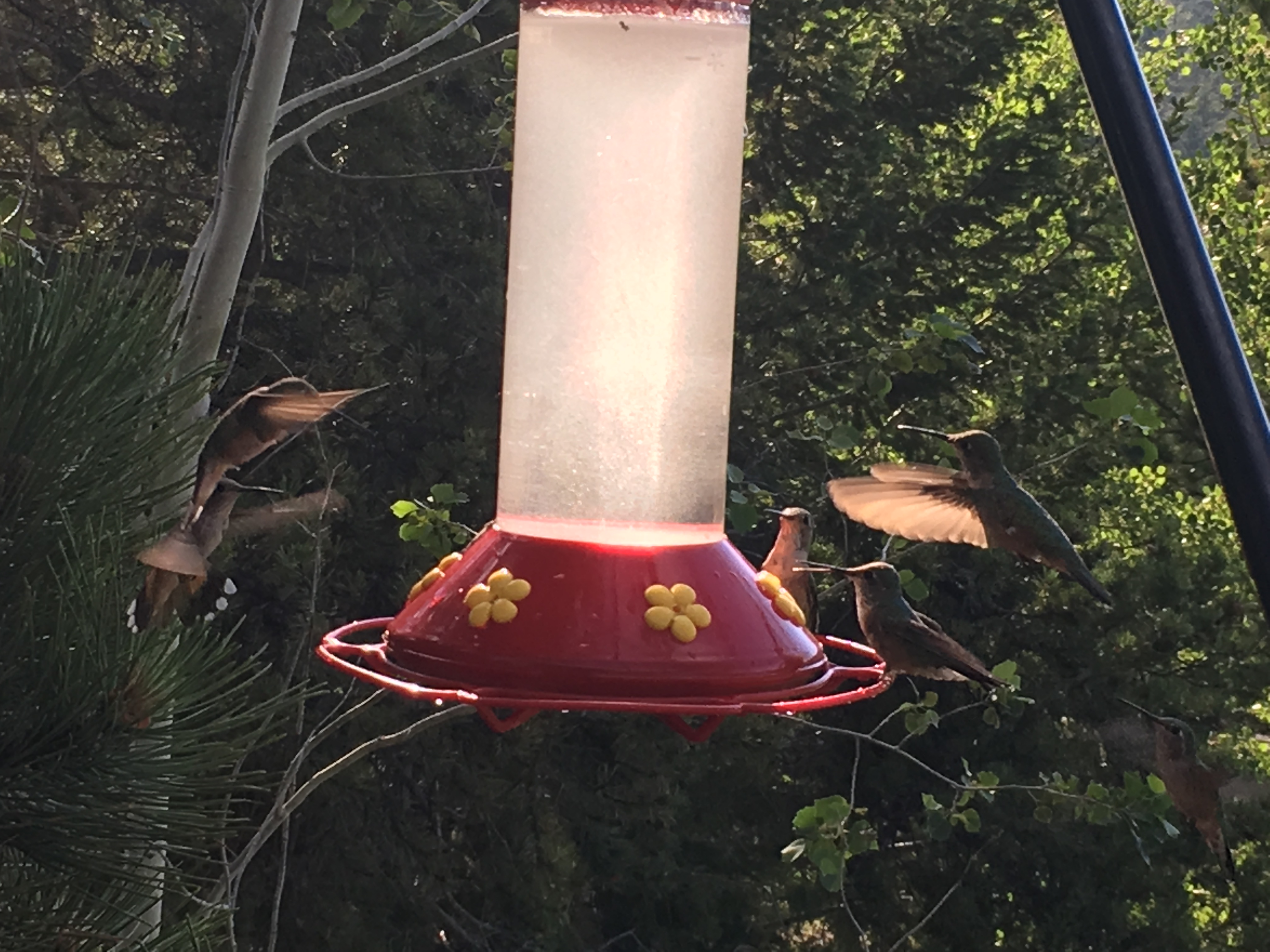
we were working in Estes Park near the Rocky Mountain
National Park where we saw many hummingbirds around a feeder in the
backyard. Here are two pictures made by Sherie S.
July 1, 2017: RHMM uses a State Licensed electrician for its electrical
work and our AARST-NRPP certified owner estimates and installs the radon
mitigation systems himself. The new NRPP certifications for testing,
mitigation and for RHMM as a radon testing laboratory have recently been received again for the next
two years. Our owner has been NRPP certified for the last 18
years, continuously.
More good economic news:
May 1, 2017: Colorado
is doing really well in the recovery. From Sept 2013 to 2017 the
unemployment
went down from 6.3% to 2.4%, and similarly, the region Fort
Collins-Loveland, CO,shows
now a low value of 2.1%. Even more remarkable is that these unemployment rates
are less than half of the national rates I refer to in the next
paragraph below. Click on this link:

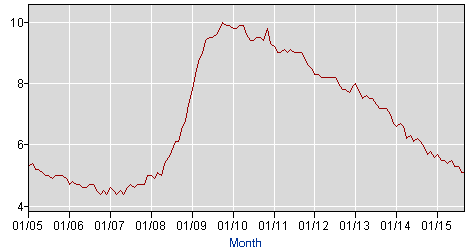
The national data show that the unemployment rate is at 4.4% (March
2017) and the average over the last year 2016, 4.7%, is now
more than one year below the average over 2007, meaning before the 2008
financial crisis. The graph of this
interesting time series can be seen at
this link:
January 4, 2017 January
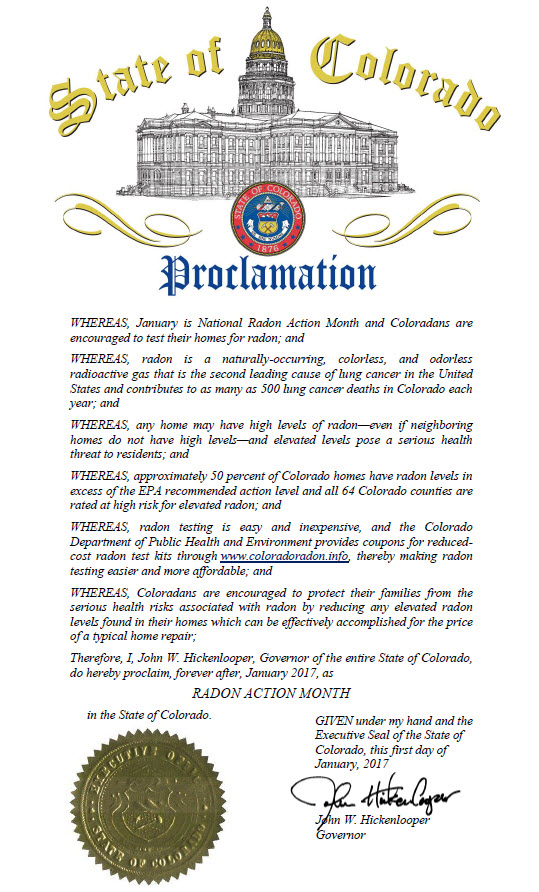
is Radon Awareness month. In Colorado the State has written a
Proclamation to this effect. Click on the following image to read that
Proclamation in detail: signed by Governor John Hickenlooper.
November 12, 2016. Today a local Home Inspector
reported to us they have found two Active Soil Depressuirization Radon
Mitigation Systems in the area that did not penetrate the concrete
slab. These systems cannot work properly. We have found some over the
years as well. This could have been detected immediately after the RMS
installation if proper radon testing with closed house conditions
following applicable EPA or AARST-ANSI standards had been done. When in a real estate
transaction we recommend buyers always conduct their own additional
test when they start living in the house.
October 16, 2016.
From Tomorrow our access to Estes Park is going to be limited because
the Thompson Canyon is closed for travel for many months until May
2017. Access via Highway 36 from Fort Collins will add
substantial miles and time.
September 18-22, 2016. Dr. Leo Moorman visited
the International Radon Symposium in San Diego, CA., organized by AARST
and jointly held with the CRCPD. He
gave a course for advanced mitigators on Sunday, allowing the students
to earn 8 hours NRPP-CE for re-certification. He also delivered two
invited scientific
presentations later in the week during the Symposium. The two
presentations will be published as contributions in
the peer reviewed proceedings of the Symposium.
August 31-September 2:
RHMM deployed short term radon tests at an educational institution in Estes Park following the
"Schools and Large Buildings" guidance. Proper testing
required 23 radon test devices for this facility.
August 24-26, 2016 with
temperatures cooler than most of the Summer, RHMM is measuring radon
levels in 80 apartments locally, and finishing up with 14 final tests
at the Air Force.
July 24, 2016 RHMM is starting this week to mitigate 10 Large Buildings, each with 8 apartments located in Fort Collins.
July 20, 2016 We
finished a large survey with 470 radon tests at the F.E. Warren Air
Force base in Cheyenne, WY. All newly built housing for personnel must
be tested within the first 5 years of occupancy. The report
shows in detail that we passed all the required Quality Assurance and
Controls that are needed in case of such a large survey. That
means we proved that the radon tests were sufficiently accurate to
make mitigation decisions.
July 9, 2016 The
proof of new membership of AARST is in. This is the official
National organization working hard to promote (1) education
and
proper insurances for its members, (2) administer the development
of National radon standards and (3) administer the AARST-NRPP
certification program for Testing and Mitigation and (4) organize a
yearly National Symposium for its members
which in September 2016 will be held in San Diego. AARST also
has
members pledge (5) they abide by proper industry and busines
ethics as they deal with the public and promote the risk reduction
of such a sensitive issue as lung cancer causing radon
gas. At RHMM we are proud our president has been a member of AARST
for
the last 16 years and has actively helped develop and
improve the organization via a past two term National Board membership
and by
cooperating in
standard writing committees and the review committee for the Symposium
publications. This is a very valid organization to the public
by that it improves the
trust in radon testing and mitigation when performed by certified
AARST-NRPP members,
especially in otherwise environmentally unregulated states such as in
Colorado and Wyoming and others.
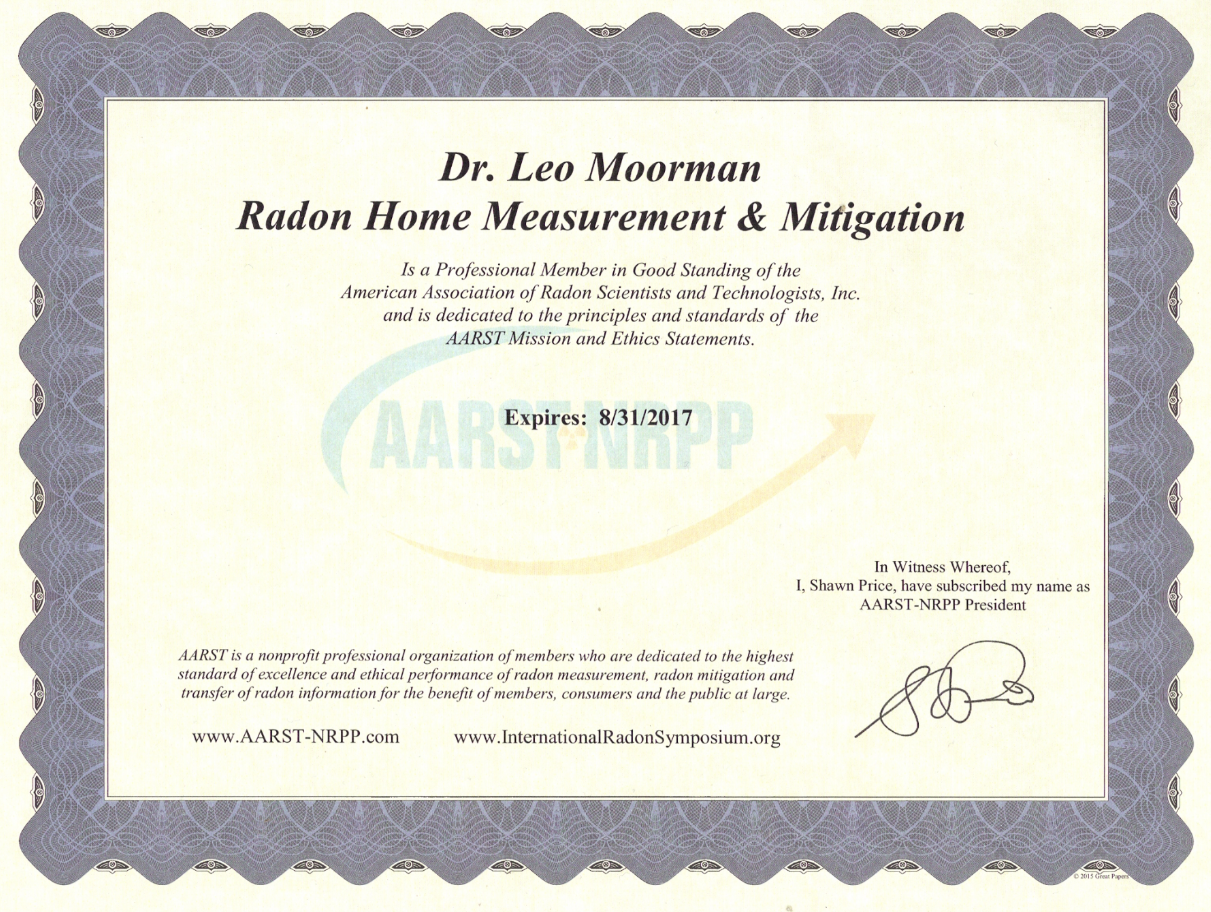
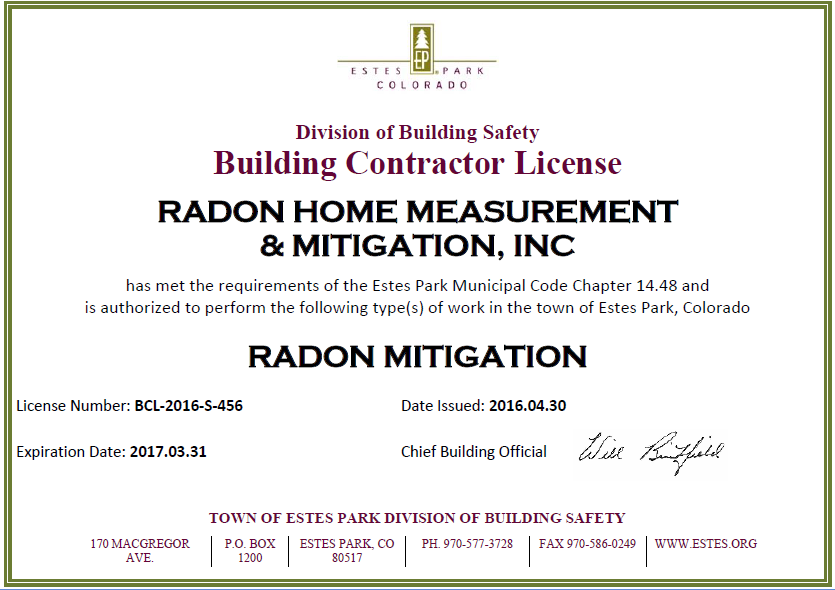
April 30, 2016: We became
a licensed contractor for Estes Park, We have also had for more than a
decade a business license for Estes Park. Nevertheless, the contractor
license is a new requirement for every contractor operating in the Town
of Estes Park in Colorado.
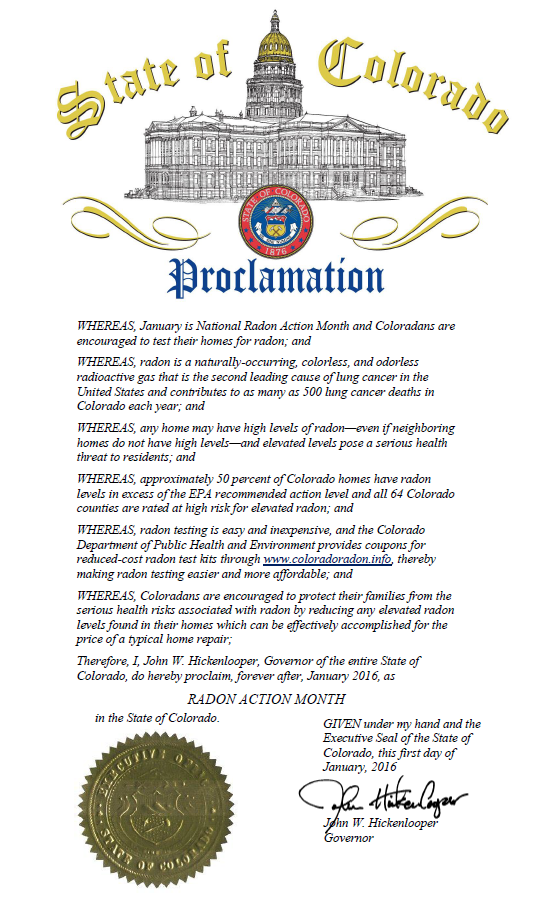
January 8, 2016 January
is Radon Awareness month. In Colorado the State has written a
Proclamation to this effect. Click on the following image to read that
Proclamation in detail:
December 10,
2015 Listen to this story about radon, lung and brain cancer and the fight of Jan Poulsen
in Utah who does not let herself be defeated by the knowledge that
radon in her house caused a problem in the past. Check out this story by Nadia Crow from ABC 4 UTAH:

December 7,
2015 Here
is a Christmas shopping idea: A gift of a radon test from
parents
to children can be a perfect, economical and easy gift even
if the home has been tested in the past. Such a gift for now
or
January 2016
would contribute to your family's future health. The
Environmental Protection Agency has made January the National
Radon Protection Month and recommends testing a home for radon
regularly whether a radon mitigation system is installed or
not.

November 26, 2015 Update
of USA Building Codes related to radon system
requirements: Currently 8
states
have radon in new home construction Code adopted. This is either as
App. F (MD, MI, WA,),
App. F or CCAH (MA),
and/or
an Amendment of App. F (IL, MA, MN, OR),
or wrote their own Code (NJ).
In
addition there are 3
states
with adoptions that are not statewide: App. F (FL,
VA, local only) and ASTM 1465 (ME,
if builder incorporates RRNC).
In addition , Colorado is a State with decentralized building code
adoptions by the individual municipalities. As an example, Fort Collins
and Larimer County (and many others) have App. F requirements. Check
your local building Code department for details.
November 25, 2015, the evening
before Thanksgiving day. Rocky
Mountain PBS showed "Einstein's big idea. The story behind the world's
most famous equation, E equals m c squared." An educational story about
the discoveries that lead to the understanding that energy and mass can
be converted into each other. It also explains Lise Meitner's
role
in the discovery of man made nuclear fission (at the time
misclassified as "fusion"). With this we mean that she was the first
human to understand that atomic nuclei had been
split
in the laboratory during an experiment and used
Einstein's
equation to proof that this is indeed possible.
It also mentions the rough deal she got
by her immediate colleagues that is now well recognized. Click on
pictures below for two different sources. (The discovery is depicted 1
hr 49 min into the movie).
 
STARTING
POSITION IN RADON MITIGATION NOW AVAILABLE.
For more info and application form: CLICK
HERE

Radon Home Measurement
and Mitigation (RHMM) performs radon testing and radon mitigation of
single and multi-family
homes as well as radon testing and mitigation in commercial or business
locations, and delivers radon education to
interested groups and the public. RHMM also helps with radon
issues
emerging during real estate transactions, helping real estate brokers,
buyers and sellers to understand and deal with what may be a serious
environmental health issue in a home. Our goal is to identify those
places that represent a high radon exposure to the general public in
residential, commercial and business environment and, after
verification of an increased health risk, to fix the problem.
Furthermore
RHMM works with home owners, contractors and builders by pre-screening
a
building site before construction for its ability to show a radon risk
concern after completion. If this radon risk analysis shows a predicted
high concentration of radon, RHMM can install an effective
pre-mitigation system in new home construction. RHMM, located in Fort
Collins, can solve radon problems anywhere in Northern Colorado or
Wyoming.
 Last
update May 19, 2017
Last
update May 19, 2017
November 21, 2015:
First mandated, residential radon testing during Real Estate
transactions in a local municipality in the USA has now been
adopted.
The Montgomery County council (Maryland) decided last Tuesday
unanimously to require testing of each house for radon by a
Seller
during a real estate transaction and that the results be provided to
the
Buyer.
The
Washington Post, November 17.
November 15, 2015:
Every year in
the USA 21,000 people acquire radon related lung
cancer according to the EPA, which means an average
of 58 people per day. Most of
these lung cancers are preventable if all the
houses the affected people had
lived in during their lifetime had properly working radon mitigation
systems installed. In addition the EPA advice is to test homes
with working
radon systems regularly, such as once every two years, because the
radon entry pathway into a house can change over time.
November 8, 2015: RHMM
installed quality radon mitigation systems in the last two
weeks in
Fort Collins, Loveland, Estes Park, Livermore, all located in Colorado,
as well as in Lander, Wyoming. We also helped two new mitigators pass
the practical requirement for their NRPP mitigation
certification.
September 20, 2015 Our president
Dr. L. Moorman taught a course entitled "Advanced Techniques
For
Radon Mitigation Systems" at the Bloomington, MN, AARST
Symposium
to a well attended audience.
Experienced mitigators were able to earn 8 hours
continuing education with this course under the
AARST-NRPP program, the longest running professional radon
certification
program in the USA.
In all, 56 students
passed the
exam and earned a certificate. Kudos to all!
June 8,
2015:
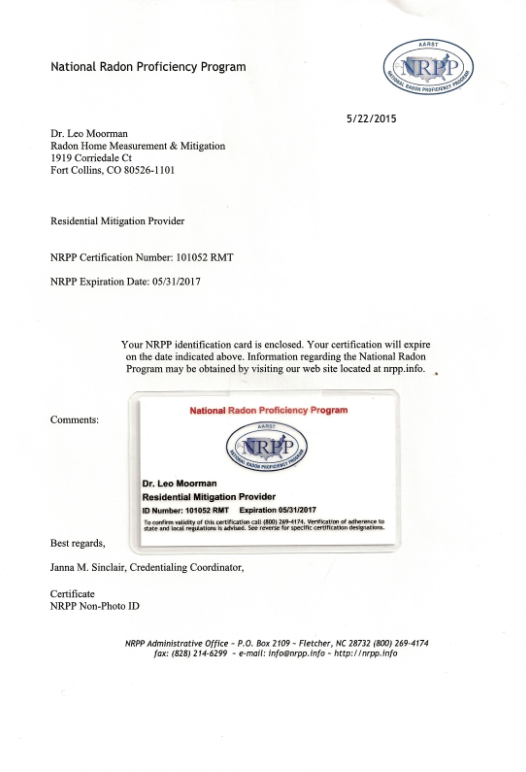
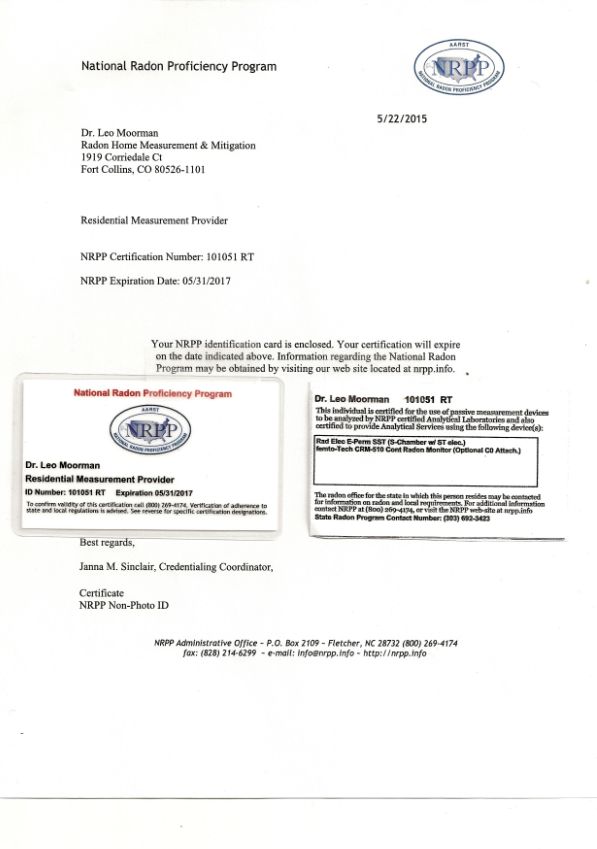
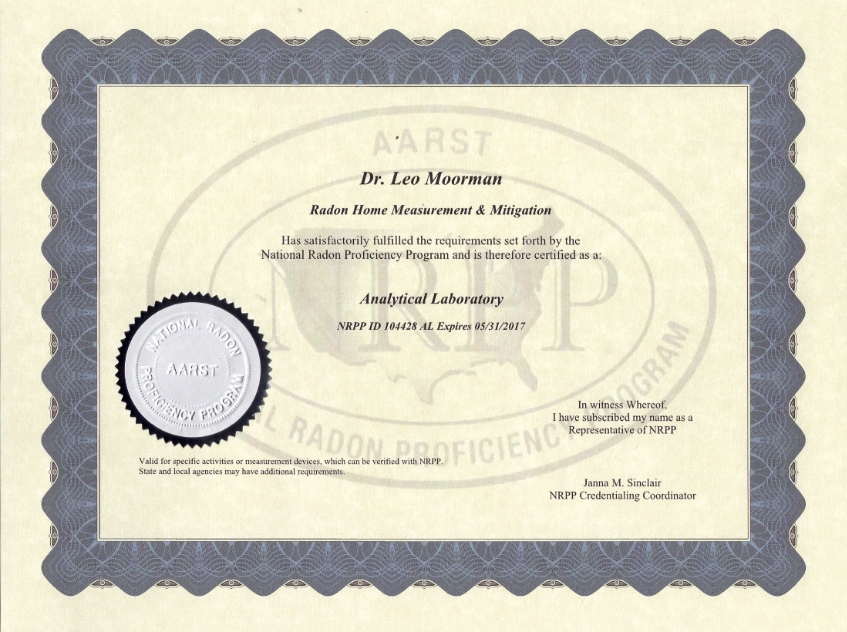
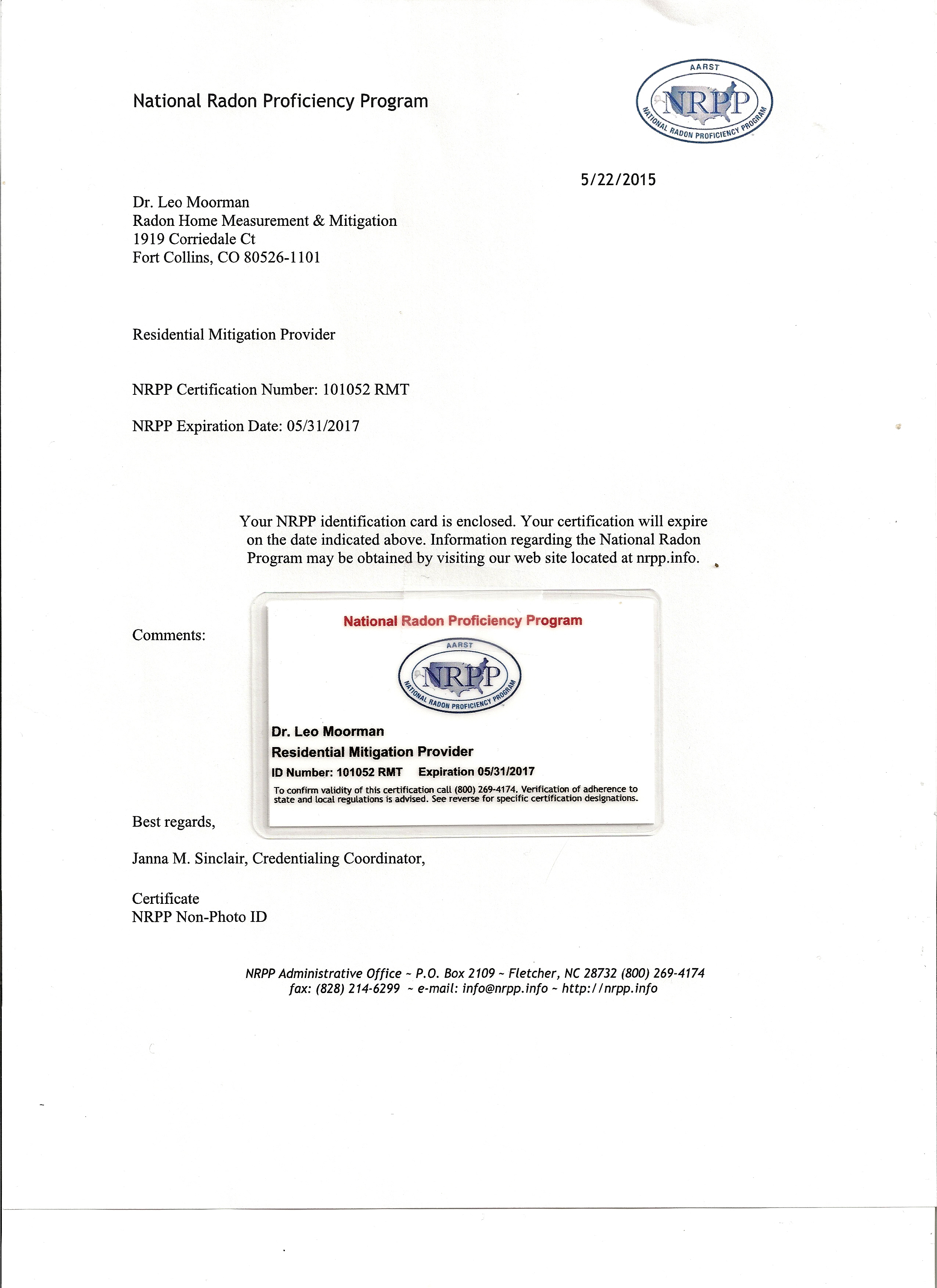
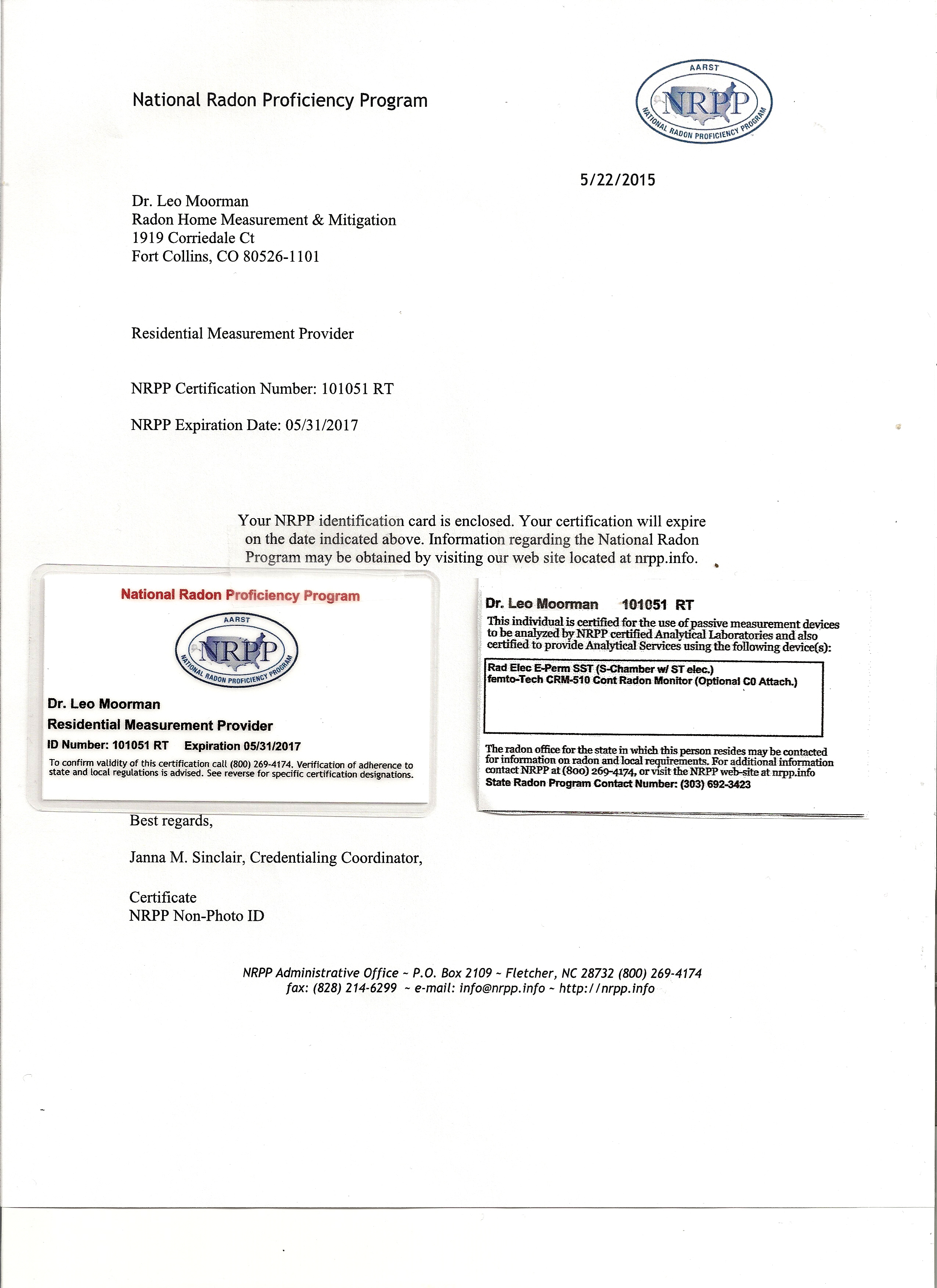
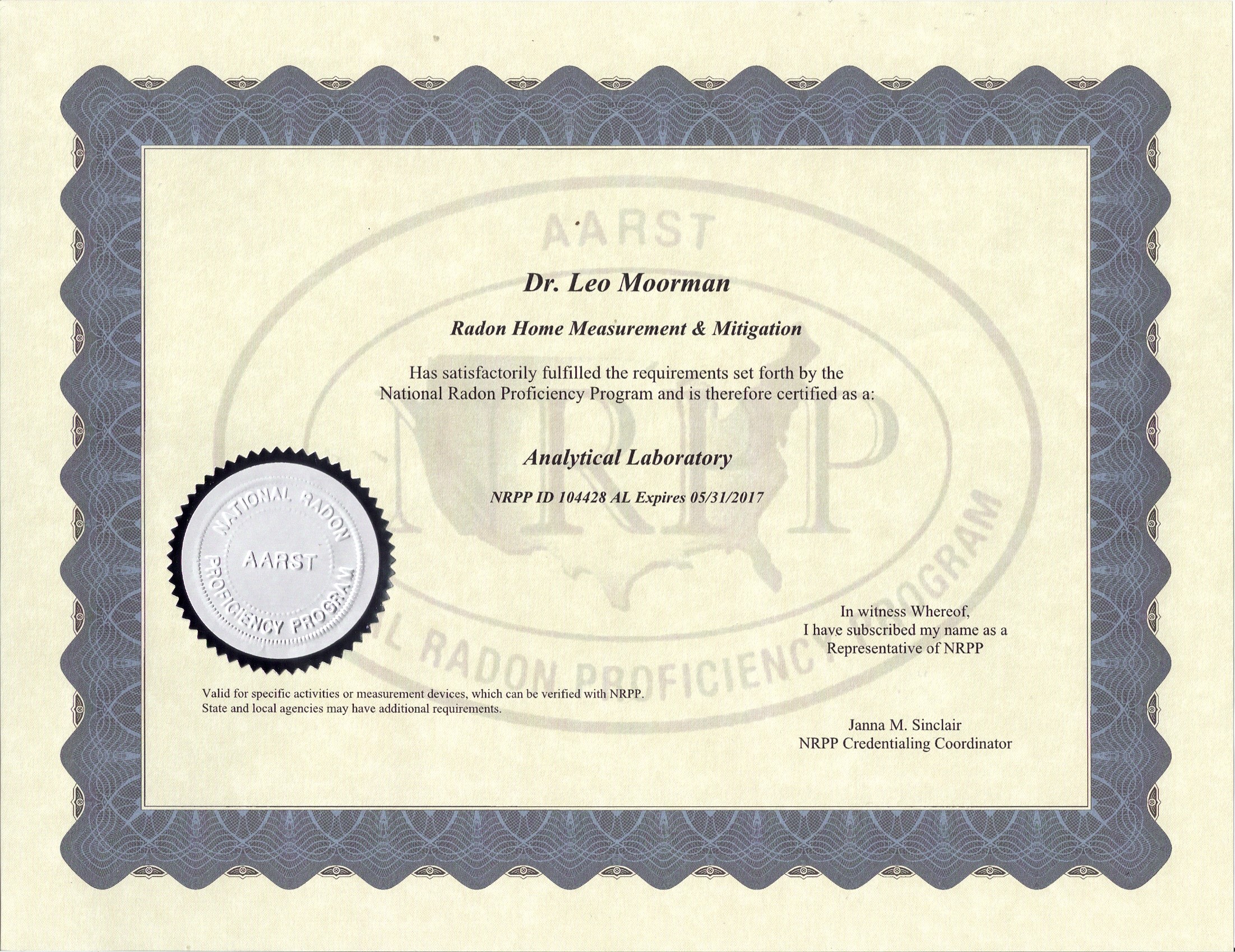
The bi-annual certificates from the NRPP-AARST as a proof of
recertification arrived in our office
today after we had forewarded to them proof of (1) Continuous
Education, (2) instruments calibration and (3) performance
testing.
Certification for radon mitigation, radon measurement and as a
radon laboratory, to provide radon test devices to the public, is
approved until
May 31, 2017. We have been certified for radon services
continuously
since 1999 and have since installed more than 1850 high quality
mitigation systems as well as completed more than 3600 radon
tests with reports following EPA guidelines. Click on the images for
details:
Mitigation:
Measurement:
Laboratory:
January 5, 2015 January
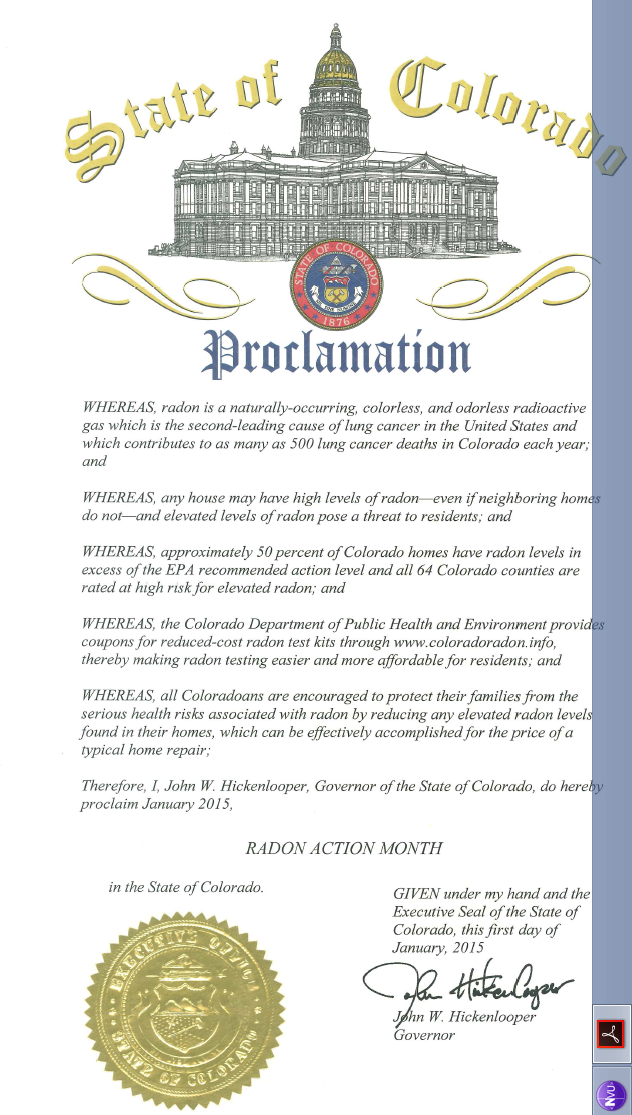
is National Radon Action Month. More specifically the
Governor of the State of Colorado, John Hickenlooper, has made
his
own
Proclamation that January is Radon Action Month for the State of
Colorado. Click on this image to enlarge and read the entire
Proclamation:
December 30, 2014
Mae Kaene dies at 107 years old. She was the
last of the
surviving group of radium dial girls that painted with radium on wrist
watch
dials to make them glow in the dark for the US Radium Corp in
the
early 1920's. She survived likely by quitting her job after a few
days because she did not like the "taste of radium".
December
14, 2014 A
new course entitled "Advanced
Techniques For Radon Mitigation Systems" is approved by the
NRPP-AARST for continuing education credits (8 hours CEU) for radon
mitigators. The course will be given by our president Dr. L.
Moorman. For more course information, locations and dates or if you are
interested to bring this course to your own State program
write us
by using the "contact
us" button at top right and use as subject title:
"ATRMS-course".
(State of Nebraska CE licensing approved)
December 12, 2014 If
you are interested in historically important events on radon, watch the
educational video by clicking on the link at the bottom of this column
about the discovery of the
element radon (Radon-222). In the last part of the video you can view
its radioactivity in an "ionization chamber" with an explanation what
you are looking at (Thoron=Radon-220).
April
11, 2014 The
Colorado Department of Public Health and Environment (CDPHE) has given
us the information that currently 22 municipalities in Colorado have a
Radon Code. This has been steadily growing since Aspen in 2003 and Fort
Collins in 2005 started this trend.
March 31,
2014 New data (CDPHE) have revealed that twelve
Colorado Counties previously considered to be at moderate risk for
radon
exposure have been upgraded to the high-risk category. This
means all 64 Colorado
counties are now categorized
as Zone I, which is the category with highest average radon
following the EPA classification. When a house is at or above
4.0
pCi/L, the USEPA recommends mitigation.
March 17,
2014
Spring is here: this is a good time to do a radon test.
Although you need to know that a
proper short
term (>=2 days) test is conducted with outside doors and windows
closed, except you can live there and may open doors to go in and out
of the home, of course.
October
20-26, 2013
Federal Radon
Awareness Week is here according to The Surgeon General. Health
agencies throughout the United States have joined forces to promote
awareness of the leading cause of lung cancer for non-smokers.
The American Lung Association Centers for disease Control, and National
Cancer Institute all agree the radon is a national
health problem and encourage radon testing during
the October awareness drive.
June 2, 2013, More
good news:
After more than two thousand years a “weak version”
of the ancient mathematical
riddle in number theory, Euclid’s “twin prime
conjecture”, is said to have been
proven. Yithang Zhang, also known as “Tom” around
the campus of University of New Hampshire
has his paper accepted in a prestigeous mathematical journal., and has
gotten instant rock star status under mathematicians.
The conjecture states “There
are an infinite number of primes that are only 2 units apart”,
such as the numerical pairs (3,5), (5,7), (11,13), (17,19),
etc. He
is said to have proven it in his manuscript not for “2
units apart”, but instead for “70 million units apart”.
Most importantly he said he
contributes his success to “never giving up on a
problem” and said he "got the
idea while visiting a friend in Colorado
on vacation".
(Source: New Hampshire Union Leader, Sun, Jun 02).
March 19
& 20 is National Radon Action day by
the organizations
AARST, NRPP, and CanSar. This is an event focussed on the need to
bringing more attention to effective radon policy.
February 28,
2013: Fort Collins Chamber of Commerce holds Red
Carpet event for Radon Home Measurement and Mitigation, Inc.
Dr.
Moorman, President and Founder of R.H.M.M. gave an inspiring power
point presentation before the Ambassadors of the
Chamber,
explaining what Radon is and how his company has saved now more than 28
lives since it began installing mitigation systems in homes.
February 4,
2013: HUD releases requirement for multifamily homes to
test for radon following the AARST/ANSI Multi-family Home
Standards,
and if high, mitigate these buildings when an FHA loan is written.
About 100,000 mortgages are involved every year.
(January 1, 2005):
Passive Radon
Mitigation Systems are now REQUIRED by current Building Code in Fort
Collins (first in Colorado) for New Home Construction of one- and
two-family
dwellings. which was extended in 2008 to all multifamily dwellings.
BAD ODOR OR MUSTY SMELL SOMEWHERE IN YOUR
HOME: go to our MOLD page
for more information.
CHEAP vs. QUALITY. If you wonder
whether all systems are
accomplishing the same goals and what the difference is between a cheap
and quality radon mitigation system. Read more ...
RADON IN YOUR WELL WATER: If you live in
the mountains and have measured a high radon level in your
indoor air, you may also want to consider testing the radon level of
the water from your Well. More
...
15 MUNICIPALITIES (9 CITIES and 6 COUNTIES)
in the State of
Colorado have requirements for installing passive systems in
new
homes currently. Check if your municipality has this
requirement on the following page (October
2011) More
...
To
see
the following short videos, click on the images, skip any
advertisement videos and use your return arrow of your
browser to
get back to this page:
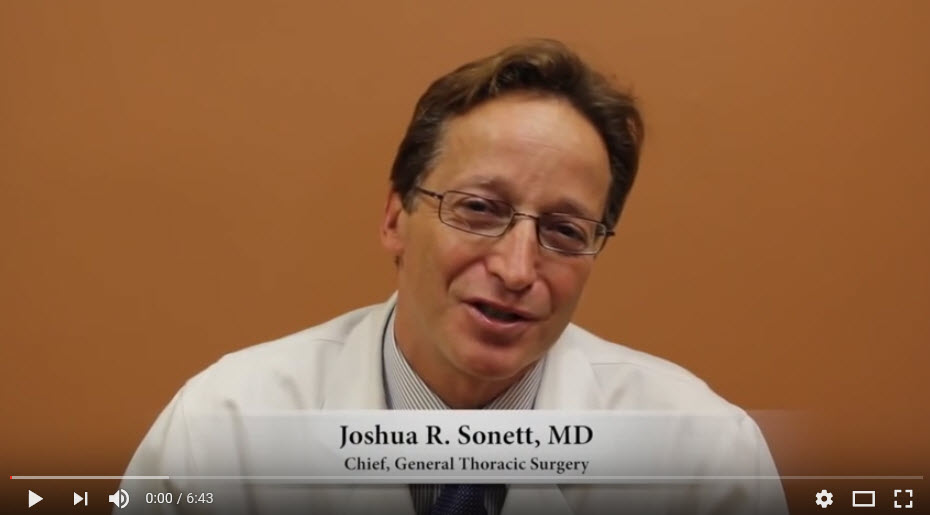
(1) VIDEO CLIP ON LUNG CANCER CAUSES and
when to take action to see a doctor, what type of lung cancers there are, and
stages, from Joshua R. Sonett, MD,
Chief, General Thoracic Surgery of the New York Presbyterian Hospital associated with
Columbia University:
(2) Two youtube
VIDEO
CLIPS on our company:

(3) Educational: On
the history of radon discovery.
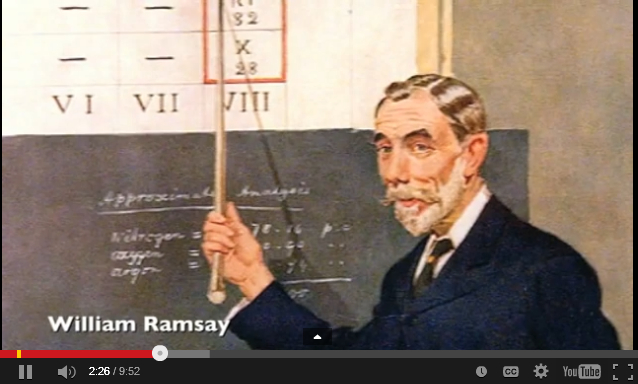
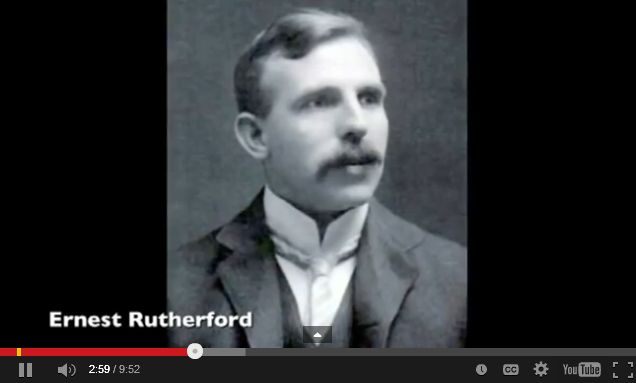
A wonderful TED talk about the discovery of radon and the two famous
scientists who competed over a century ago for the honor of its
discovery. Rutherford vs. Ramsay. How did they discover it? By
looking at the "ultraviolet (UV) light spectrum" and
identifying it as different
from other known ultraviolet light spectra, such as that from helium.
In this Ted talk the original ultraviolet light spectrum recorded by
Rutherford is shown identifying the UV light spectrum of the then
entirely new element, called Radium Emanation (Rutherford) or
Niton (by Ramsay), which later became "Radon".
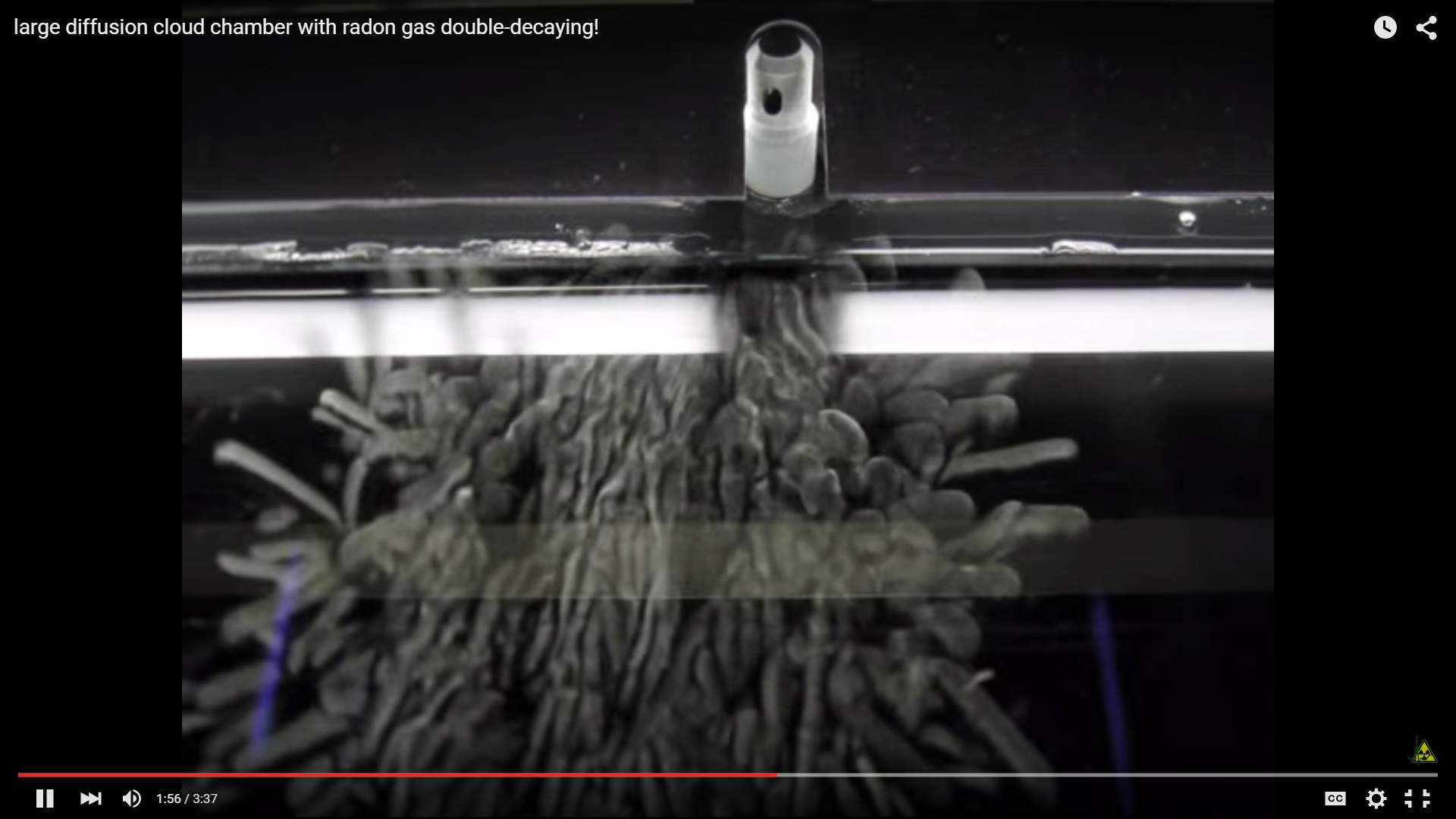
(4) Particle
decay, including that of a radon isotope (Radon-220) can be made
visible as shown in this movie.
A so called "diffusion cloud chamber" can show the alpha
tracks in real life after radioactive decay when the ionizing
alpha particles released by the
atomic nucleus create milions of tiny (mist) droplets along their
pathway through a supersaturated vapor.
The alpha particles start with a
daunting velocity of 20%
of the speed of light. This instrument is called a "cloud
chamber"
since the principle on which it works is reminiscent of the process how
clouds are formed in the sky.
|

















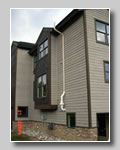 The
photo on the right shows an example of an exterior mitigation
system that was recently completed in a multiple
family
housing unit where no interior system was possible.
The
photo on the right shows an example of an exterior mitigation
system that was recently completed in a multiple
family
housing unit where no interior system was possible. Indoor Air Quality Investigation at the Western
Wyoming Community College. RHMM was hired to help evaluate the overall
air quality throughout campus.
Indoor Air Quality Investigation at the Western
Wyoming Community College. RHMM was hired to help evaluate the overall
air quality throughout campus.